
Why Data Center Opposition Is the AI Infrastructure Risk Most Boards Haven’t Modeled Early Enough
In September 2025, Google withdrew a contested data center rezoning proposal in Franklin Township, outside Indianapolis, days before the city-county council was expected to vote it down. Months of organized resident opposition had turned what should have been a routine land-use approval into a defeat the company chose not to wait for.
A Google spokesperson’s statement after the withdrawal was brief and telling: “While we are disappointed that this project is not moving forward, we look forward to continued opportunities for growth in the state.”
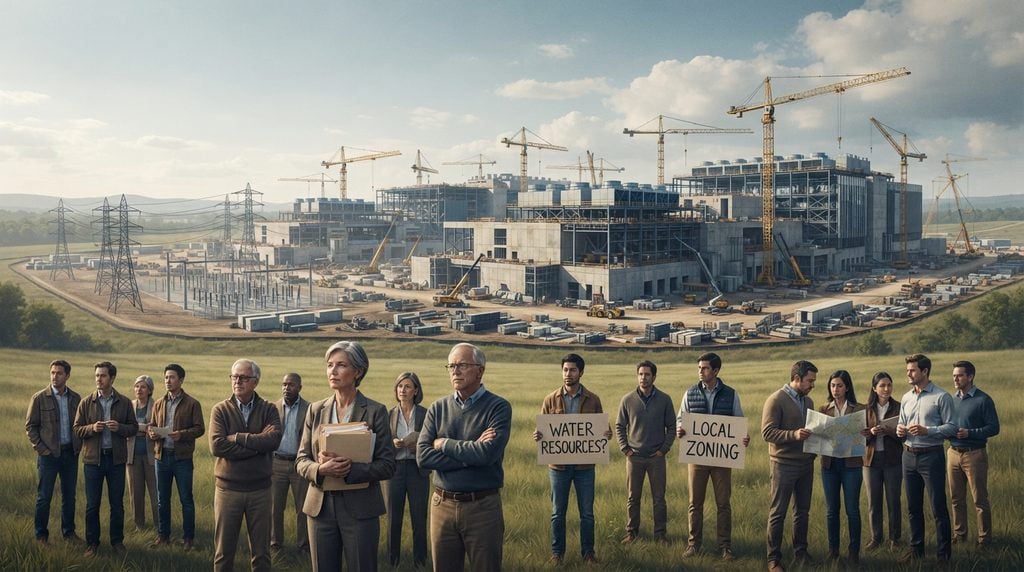
Boards evaluating AI infrastructure strategy have spent two years building increasingly sophisticated models for capital expenditure, expected return, and workforce disruption. Almost none have built a model for the risk that a project simply gets stopped, not by a competitor or a market shift, but by a county commission, a state legislature, or an organized coalition of residents who were never consulted. Data center opposition, once a scattered local phenomenon, has become one of the defining forces shaping where and whether AI infrastructure gets built at all.
The Scale of Data Center Opposition
The dollar figures tracked by Data Center Watch show how quickly data center opposition has escalated. From May 2024 through March 2025, $64 billion in data center projects were blocked or delayed amid local opposition across 28 states. In just the second half of 2025 alone, that figure reached at least $156 billion.
While Data Center opposition is not an exclusive cause of project delays, it has become a significant factor to consider alongside utility availability, infrastructure readiness, and regulatory compliance. To be clear, this is not simply performative activism but a cautious accounting of a real and growing constraint.
The clearest illustration of how fast this can move is the Stratos Project in Box Elder County, Utah, a proposed $100 billion, 40,000-acre AI data center campus projected to consume 7.5 to 9 gigawatts at full build-out, roughly double the state’s entire peak energy demand. Investor Kevin O’Leary initially dismissed community objections. Utah’s Republican Senate President J. Stuart Adams sent a formal demand letter calling for a 75% reduction in the project’s footprint. A Deseret News poll of Utah voters found 53% opposed the project as originally proposed. O’Leary reversed course entirely, telling NBC News “I have no choice,” and later, more bluntly, “We screwed up. We pissed off a lot of people.”
This is not a partisan story. A Republican state senate president drove the Utah reversal. A Democratic governor drove a statewide moratorium in New York. Opposition to AI infrastructure is organizing across the political spectrum, which is precisely what makes it a durable business risk rather than a passing cultural moment.
The Political Money War
Data center opposition has also become an organized, funded, electorally consequential force, not merely scattered local complaints. The broader AI backlash now has real money behind it, on both sides.
Leading the Future, the super PAC backed by OpenAI co-founder Greg Brockman, Marc Andreessen, and Ben Horowitz, has raised $75.79 million in confirmed FEC receipts and has spent in primary races across Texas, Illinois, and New York. In one New York State Assembly race, reporting places LTF spending against a single candidate at more than $7 million.
In direct response, Guardrails Alliance formed as a counterweight, backed by AI safety researchers and union members, launching with a $250,000 ad buy supporting the same candidate.
The fact that a single state legislative race can attract seven-figure spending tied directly to AI policy is remarkable. AI infrastructure and AI regulation are no longer a distant Washington conversation. They are now local and state-level electoral battles with real capital behind them, and that capital can move in either direction depending on what a community decides.
AI strategy now has a place-based political-risk component, one that can change a project’s scope, timing, cost, or viability even when the underlying technology case remains compelling.
The Legislative Momentum Is Broader Than One State
New York’s moratorium, signed by Governor Kathy Hochul in July 2026, pausing new hyperscale project permits for up to a year, was not an isolated event. NBC reported that data center moratorium proposals were introduced in fourteen states in the first quarter of 2026 alone, sponsored by lawmakers from both parties.
The federal picture is genuinely bipartisan in a way boards should take seriously. Senator Bernie Sanders and Representative Alexandria Ocasio-Cortez introduced the AI Data Center Moratorium Act in March 2026. Separately, Republican Senator Josh Hawley introduced the AI-Related Job Impacts Clarity Act, which would require companies to publicly disclose AI-related layoffs, AI-linked hiring, and retraining activity on a quarterly basis.
The tension is mounting. Federal executive policy has moved to accelerate AI infrastructure permitting and the use of federal land. But state and local authorities retain real power to impose land use, utility, environmental, and now disclosure constraints. That is not regulatory clarity. It is an active conflict, and it means the rules a board plans around today may not be the rules in place by the time a project breaks ground.
If the Industry Were to Make Its Best Case
Perhaps the best case developers might make is that data centers represent genuinely large capital investment, generate meaningful construction employment during the building phase, and produce real property and sales tax revenue for host jurisdictions.
But that case deserves scrutiny particularly on two points communities raise most often. The first is permanent employment. Once construction ends, a completed hyperscale data center typically operates with a small full-time staff, a detail that tends to go unmentioned in the early pitch and only becomes clear to residents after approval.
The second is water. Federal research from the Congressional Research Service, published this month, found that public water systems supply roughly 97% of US data centers’ onsite water needs. In Loudoun County, Virginia, the world’s largest data center hub, the local water authority relies heavily on potable, drinking-quality water for cooling specifically because reclaimed water infrastructure has not been built out. Reclaimed water is a real and growing option, Google now uses it at roughly a quarter of its campuses, but it remains the exception rather than the rule across the industry, and it typically requires a separate non-drinking-water pipeline most municipalities have not installed. When a community asks whether a data center is drinking their water, in most cases today, the honest answer is yes.
None of this means the industry’s economic case is false. It means the case is incomplete as typically presented, and incomplete pitches are precisely what has been fueling the reversals detailed above.
The Engagement Nobody Modeled
One striking detail is common in nearly every reversal cited in this piece, and it complicates the idea that data center opposition is simply an unavoidable cost of doing business: much of the data center opposition appears to be manageable. And the industry’s own research says so. Some communities will oppose a multi-gigawatt project regardless of how well it is communicated. But the evidence suggests a meaningful share of the worst outcomes trace back to timing and sequencing, not to opposition that was inevitable from the start.
Industry analysis found that while 93% of people support digital infrastructure in general, local support drops to just 35% once a specific project is proposed nearby, and developers who begin community outreach only 6 to 18 months into a project are, by that point, managing expensive damage control on capital investments running $20 million to $50 million per megawatt. One firm built an entire consulting practice around this exact failure, launching a “Community Risk and Readiness Assessment” explicitly because, in the firm’s own words, “too many projects face resistance not because of poor design or site choice, but because local stakeholders were not understood or engaged soon enough.”
A rural Wisconsin project offers a vivid illustration of what happens without that groundwork. Former New York City Mayor Eric Adams was brought in to advocate for a proposed data center and was interrupted by boos before he could finish his introduction, residents accusing the project of coming to “steal our water” and openly questioning why an outsider had been sent to sell it to them.
Contrast that with what is unfolding right now, this month, in downtown Oakland. Developer Behring Companies has proposed converting a small former supercomputer facility into a 20,000-square-foot AI data center, a fraction of the scale of a project like Stratos. Rather than announcing and defending, the developer and the district’s city councilmember, Carroll Fife, have appeared together publicly, held a community meeting inside the building itself, and worked deliberately to separate this project from the sprawling, resource-intensive campuses that have driven opposition elsewhere. There is still real organized resistance, a “No Data Centers in Oakland” campaign has drawn support including from Olympic gold medalist Alysa Liu, but the difference in approach is instructive. Visible engagement does not guarantee approval. But it does change the conversation from confrontation to negotiation.
This raises a genuine leadership question, though not the one it might first appear to be. Public policy and community relations is not a function the AI infrastructure industry needs to invent. It is an established, well-compensated executive discipline, senior roles routinely command $400,000 or more annually, and Google’s own dedicated public affairs team for regional data centers proves the capability is already understood at the companies that have been doing this longest. The more interesting question is not whether this function exists. It is where that function sits in the decision-making process, and when it gets a seat at the table. Too many of the projects generating the worst headlines brought community and political expertise in after the site was chosen and the opposition had already organized, treating it as a communications response rather than a development input alongside power, land, and water.
That distinction between a capability that exists and a capability that is actually empowered early enough to shape the decision is important to consider before jumping to what it means for hiring.
The Question for the Next Site Selection Meeting
Before the next AI infrastructure decision goes to committee, the board should be able to answer one question with the same rigor it applies to capital cost: what is the realistic political and community risk profile of this specific site, and who is accountable for managing it before the opposition organizes, not after.
Google, Amazon, and Kevin O’Leary all learned this lesson the same way: after committing capital, after data center opposition mounted, after reversal became the only option left. Oakland’s still-unfolding project suggests the alternative is not complicated, it is simply earlier. The boards getting ahead of the broader AI backlash now are the ones treating community and political risk as a genuine line item in AI infrastructure strategy, staffed and empowered before the shovels are in the ground, not managed as an afterthought once it becomes a headline.
Pricing a Risk That Isn’t on the Balance Sheet
Every board evaluating an AI infrastructure commitment has, by now, built a model for capital expenditure, timeline, and expected return. But few have built a model for the possibility that a county commission, a state senate president, or an organized coalition of residents changes the scope, timeline, or viability of the project entirely, regardless of how sound the underlying technology case is.
The capability to manage that risk is not missing from the market. What may be missing, at the specific companies generating the worst outcomes, is a version of that capability integrated tightly enough into site selection and development to actually change which sites get chosen and how projects get structured before capital is committed, rather than a function that arrives once a project is already controversial. That is a different kind of executive than a traditional government affairs hire, someone who can hold site economics, political read, and community trust as one integrated judgment rather than three separate reports.
Identifying that kind of integrated judgment, the same caliber this series has called the Platinum Knowledge Worker, is precisely what Hager’s Cognitive Search Methodology was built to do. For the broader argument this post builds on, see The AI Infrastructure Trap, and for how to evaluate genuine AI judgment in a candidate directly, see How to Hire an Executive Who Actually Understands AI.
About Hager Executive Search
Hager Executive Search is a San Francisco-based retained executive search firm serving growth-stage and mission-driven organizations. Three-time Forbes-recognized among America’s Best Executive Search Firms, Hager combines management consulting rigor with retained search to diagnose organizational gaps before launching a search, including whether candidates bring genuine judgment across the full range of AI-era risk, not just the technical or financial dimensions. Learn more at hagerexecutivesearch.com.
All data and quotes in this article are linked to their original source at first mention.